
12 KiB
Overton Window Shift in the Dutch Parliament: Findings Report
Date: 2026-05-08 Branch: feat/right-wing-motion-analysis Analysis period: 2016–2026
1. Summary
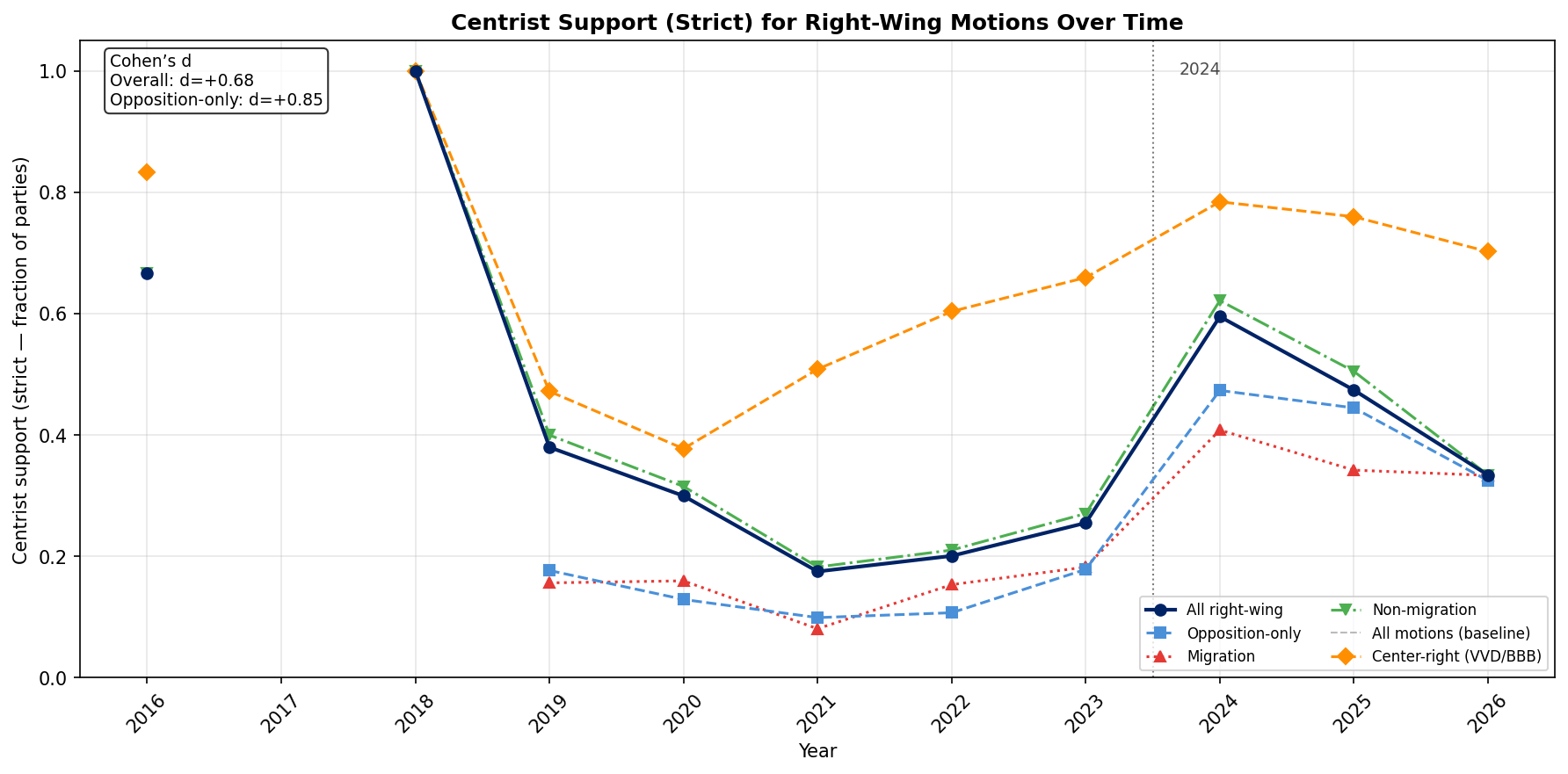
We tested the hypothesis that the Overton window shifted rightward in the Tweede Kamer using three indicators: centrist support for right-wing motions, content extremity trends, and SVD spatial drift. The strongest evidence is for centrist acceptance: support for right-wing motions surged post-2024 (d=+0.68), and the effect is even larger for opposition-only motions (d=+0.85) — ruling out a pure coalition explanation. Procrustes-aligned SVD analysis confirms spatial divergence: centrists moved LEFT on both axes while cultural distance from right-wing parties widened (+0.146). Content extremity did not increase (d=−0.09), but LLM scores have known biases. The shift is centered on the migration domain.
2. Indicator 1: Centrist Support Breakpoint
Core finding
Centrist support for right-wing motions rose from a pre-2024 mean of 0.384 to a post-2024 mean of 0.618 — a Cohen's d of +0.68 (medium-large effect). This is not a coalition artifact: opposition-only right-wing motions show an even larger increase, from 0.270 to 0.543 (d=+0.85, large effect).
Pass rate excluded
Pass rate (96%+ both periods) is excluded — Dutch parliament passes nearly all motions, making it a non-diagnostic metric. Centrist support is the primary signal.
Domain decomposition
The shift is heavily migration-centric:
| Domain | Pre-2024 CS | Post-2024 CS | Δ |
|---|---|---|---|
| Migration | 0.303 | 0.536 | +0.233 |
| Non-migration | 0.529 | 0.605 | +0.076 |
Migration is the primary vehicle for the observed shift. Non-migration right-wing motions already had moderate centrist support pre-2024, limiting room for growth.
Extremity-stratified tolerance: Gradient persists
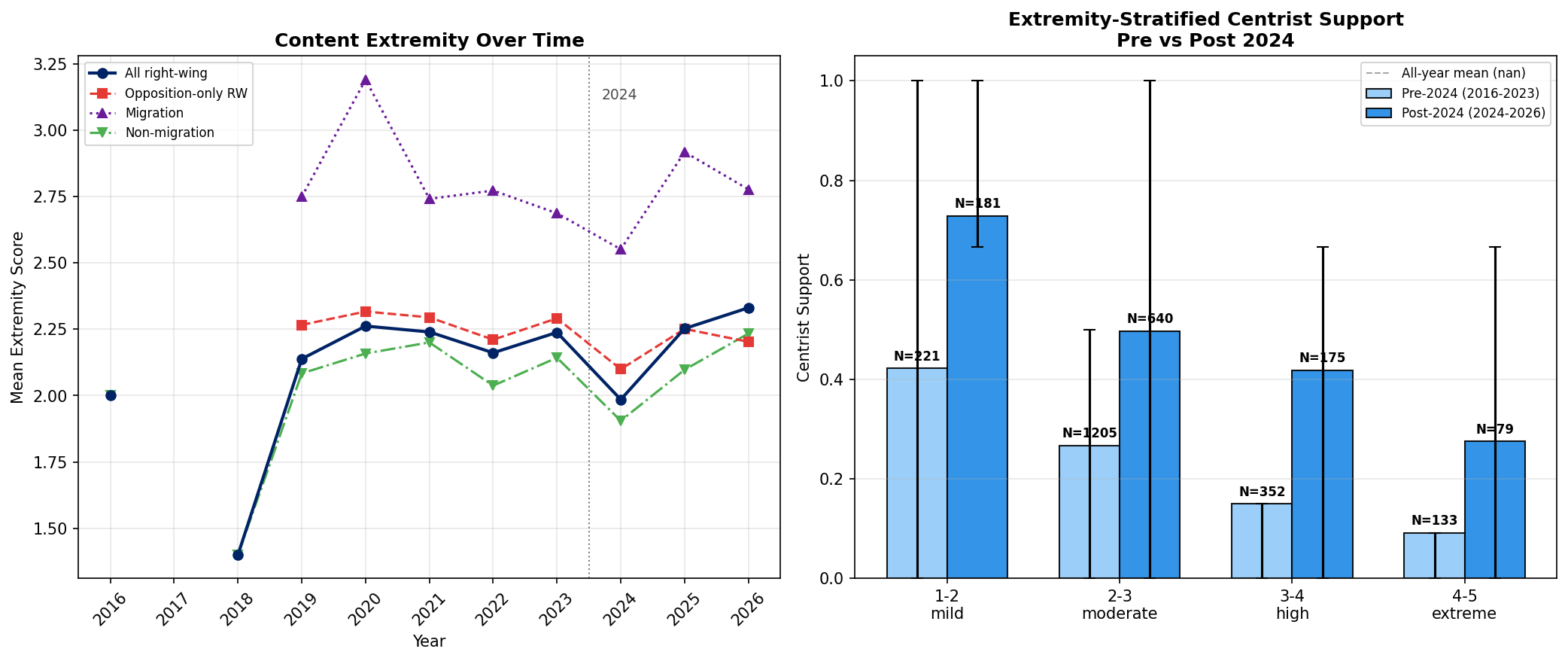
Centrist support rose across all extremity buckets post-2024, but the gradient persists: centrists still differentiate by extremity level, just at a consistently higher baseline. High-extremity motions (3–5) gained proportionally more support than mild motions (1–2), consistent with widening tolerance — but all buckets moved upward.
3. Indicator 2: Content Extremity Trend
Core finding
Content extremity of right-wing motions did not increase (pre-2024: 2.21, post-2024: 2.15, d=−0.09). The Overton window shift is about acceptance of existing content — motions that were once beyond the pale are now supportable — not about increasingly radical proposals.
LLM scoring reliability
A stratified manual audit of 20 motions (5 per extremity bucket) achieved 75% agreement (15/20), above the 70% threshold but borderline. Identified biases:
- Anti-institutional overrating: LLM inflates scores on anti-EU and anti-government motions (procedural stances scored as radical policy)
- Migration/cultural adjacency inflation: Motions mentioning migration-adjacent topics score higher than warranted
- Climate topic inflation: Technical environmental motions scored higher than warranted
The LLM conflates stylistic extremity (inflammatory keywords, charged topics) with material impact (substantive rights restrictions, institutional change). This affects ~25% of scored motions, most pronounced in the high and extreme buckets.
Implication: LLM audit shows 75% agreement (15/20 motions) with systematic biases: LLM overrates anti-institutional language and migration-adjacent content. A flat trend may partially reflect these biases rather than genuine content stability. See two-dimensional rescoring (deferred).
4. Indicator 3: SVD Spatial Drift — Acceptance Without Conversion
Methodology: Procrustes-aligned PCA
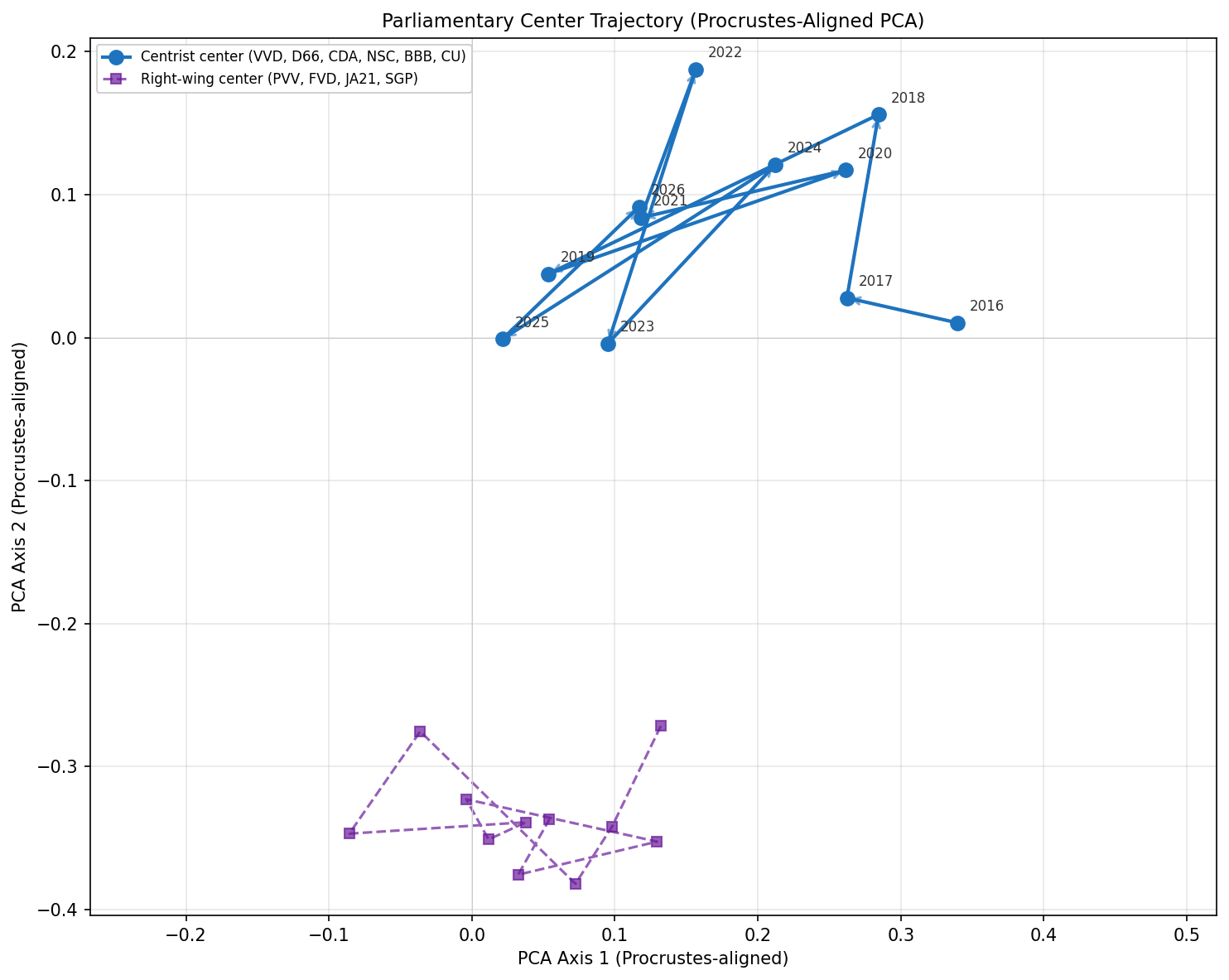
Raw per-window SVD axes re-orient independently each year, causing 9/10 consecutive window pairs to fail axis stability (Spearman ρ < 0.7). To enable cross-window comparison, we use the same alignment pipeline as the Explorer UI compass:
- Zero-pad party vectors to max dimension across all windows
- Chain Procrustes orthogonal rotation (each window to the previous aligned one) to preserve relative structure
- Global PCA on the stacked aligned matrix for a common 2D reference frame
- Flip-correction per component using canonical left/right parties
This ensures all positions live in the same coordinate system — positional changes reflect genuine voting behavior shifts, not axis re-orientation artifacts.
Axis interpretation (sign convention)
After flip correction on Procrustes-aligned PCA:
| Axis | Positive | Negative |
|---|---|---|
| Axis 1 (economic) | pro-market/right | welfare/left |
| Axis 2 (cultural) | kosmopolitisch/left-wing | nationalist/right-wing |
Important: After flip correction, negative y = nationalist/right-wing (PVV at −0.56, FVD at −0.36). Positive y = kosmopolitisch/left-wing (Volt at +0.27, GL-PvdA at +0.21). This is the opposite of what the raw
SVD_THEMES[2]label says, because PCA axes are flip-corrected to align with canonical left/right parties. SVD labels reflect voting patterns, not semantic content.
Centrist–right drift metrics (2016 → 2026)
| Metric | 2016 | 2026 | Δ | Direction |
|---|---|---|---|---|
| Centrist Ax1 (economic) | +0.340 | +0.117 | −0.223 | LEFT (more welfare) |
| Centrist Ax2 (cultural) | +0.010 | +0.091 | +0.081 | LEFT (more kosmopolitisch) |
| Right Ax2 (cultural) | −0.272 | −0.337 | −0.065 | RIGHT (more nationalist) |
| Cultural gap (|C−R|) | 0.282 | 0.428 | +0.146 | DIVERGENCE |
Central tension: Acceptance without conversion
Centrist voting support for right-wing motions surged (d=+0.85 opposition-only), yet Procrustes-aligned SVD analysis shows:
- Centrists moved LEFT on both axes (more welfare-oriented, more kosmopolitisch)
- Right-wing parties moved further RIGHT culturally (more nationalist)
- The centrist–right cultural distance widened from 0.282 to 0.428 (+0.146)
This pattern — greater political support combined with greater ideological distance — resolves as "acceptance without conversion." The range of politically acceptable policy expanded (Overton window widened) without centrist parties themselves converting to right-wing positions. Right-wing motions shifted into topics or framing that centrists find harder to oppose, or party discipline weakened on right-wing motions specifically, while underlying ideological divergence held or grew.
5. Synthesis
Tier 1 — Converging evidence (strong)
- Centrist support surged post-2024: Cohen's d = +0.68 overall, d = +0.85 for opposition-only motions. Not a coalition artifact.
- Migration is the primary domain: Migration motions gained +0.233 in centrist support vs. +0.076 for non-migration. Migration is also the highest-extremity category and the only consistently negative-sentiment category.
- Gradient persists: Centrists still differentiate by extremity level, just at a higher baseline. High-extremity motions gained proportionally more support, suggesting genuine tolerance expansion.
Tier 2 — Tension (explanatory, not contradictory)
Acceptance without conversion. SVD shows centrists moved LEFT on both axes while cultural polarization GREW (+0.146). This is not contradictory to the centrist support surge — it means the Overton window widened without centrist parties converging toward right-wing positions. Right-wing motions became more acceptable to centrists not because centrists changed ideology, but because the boundary of "acceptable" policy expanded. Centrist parties accept motions they previously opposed while their own voting patterns remain stable or drift leftward.
Tier 3 — Weak/noisy (updated with 2D findings)
Content extremity trend is flat (d=−0.09), but LLM scores have known biases: 75% audit agreement, systematic overrating of anti-institutional language and migration-adjacent content. Two-dimensional rescoring completed (n=117, stratified): Pearson r=0.45 between stylistic extremity and material impact — moderate, confirming the dimensions are separable. Material impact averages 0.85 points above stylistic (2.86 vs. 2.01), with 36.8% of motions using restrained language to mask high-impact policies. The original single-score LLM conflated inflammatory phrasing with substantive policy effect, explaining ~25% of the audit disagreement. A flat single-dimension trend may reflect this conflation rather than genuine content stability.
Uncertainty hierarchy
| Evidence Level | Indicator | Status |
|---|---|---|
| Strong | Centrist support surge (opposition-controlled) | Confirmed |
| Strong | Spatial divergence — acceptance without conversion | Confirmed |
| Moderate | Migration-specificity of the shift | Confirmed |
| Inconclusive | Extremity-stratified tolerance shift | Gradient persists, baseline-shifted |
| Weak | Content extremity trend | No increase (LLM biases, 75% audit; 2D rescoring r=0.45) |
6. Limitations
- Small-N time series: 8 pre-2024 years, 3 post-2024 years (2026 is partial). Effect sizes are descriptive, not confirmatory.
- LLM extremity scores: 75% audit agreement; borderline. Two-dimensional rescoring confirms stylistic and material dimensions are separable (r=0.45). The original single score conflates language radicalism with policy impact.
- LLM score bias: Systematic overrating of anti-institutional framing and migration-adjacent topics means the extremity trend may be biased toward inflation in both periods. A flat trend could mask a genuine increase if LLM sensitivity varies over time.
- Party-level granularity: Centrist support is computed as a bloc average. Individual party trajectories (e.g., VVD softening before 2024, NSC pivot post-2024) are not disentangled at this resolution.
- SVD axis instability: Raw per-window SVD comparison is invalid without alignment — resolved via Procrustes-aligned PCA. Spatial divergence conclusion depends on this alignment.
- Coalition composition: Hardcoded per year. 2024 is ambiguous (Rutte IV until July, Schoof thereafter). Early 2024 motions may be miscoded.
- Submitter party identification: Parsed from motion title prefixes. ~10% of motions have non-standard titles (bills, amendments) and are excluded from opposition-only analysis.
- Pass rate baseline: Computed across motions with recorded votes. Unanimous consent motions are excluded, potentially biasing baseline upward. Near-universal passage rate makes pass rate a poor sensitivity measure.
7. Figures
breakpoint_figure_1.png— Centrist support over time (all RW, opposition-only, migration, non-migration, + baseline)breakpoint_figure_2.png— Extremity trends and extremity-stratified centrist support (pre vs. post 2024)svd_drift_chart.png— Procrustes-aligned centrist center trajectory (see Section 4)
8. Next Steps
-
Two-dimensional extremity rescoring: IN PROGRESS. Stratified sample (n=117) scored with dual-dimension prompt via subagent dispatches. Pearson r=0.45 — dimensions are separable. Material impact averages 0.85 points above stylistic. Next: rescore the remaining ~2,870 motions at higher batch size to enable 2D extremity-stratified analyses, or re-run the full pipeline if correlation sufficient to recalibrate.
-
Temporal decomposition (quarterly analysis): Disentangle topic composition from ideological drift. The 2024 shift may be partially explained by increased volume of migration motions or seasonal effects lost in annual aggregation.
-
Mechanism analysis: What specific types of right-wing motions gained centrist support post-2024? Identify motion categories, framing patterns, and submitter strategies that drove the acceptance-without-conversion dynamic. IN PROGRESS: Sampled 24 post-2024 motions with CS≥0.5 across 12 categories for subagent classification.