
8.9 KiB
Overton Window Shift in the Dutch Parliament: Findings Report
Date: 2026-05-08 Branch: feat/right-wing-motion-analysis Analysis period: 2016–2026
1. Summary
We tested the hypothesis that the Overton window shifted rightward in the Tweede Kamer using three indicators: centrist support for right-wing motions, content extremity trends, and SVD spatial drift. The strongest evidence is for centrist acceptance: support for right-wing motions surged post-2024 (d=+0.68), and the effect is even larger for opposition-only motions (d=+0.85) — ruling out a pure coalition explanation. However, content extremity did not increase (d=-0.09), and SVD axes proved too unstable for cross-window comparison. The shift is centered on the migration domain.
2. Indicator 1: Centrist Support Breakpoint
Core finding
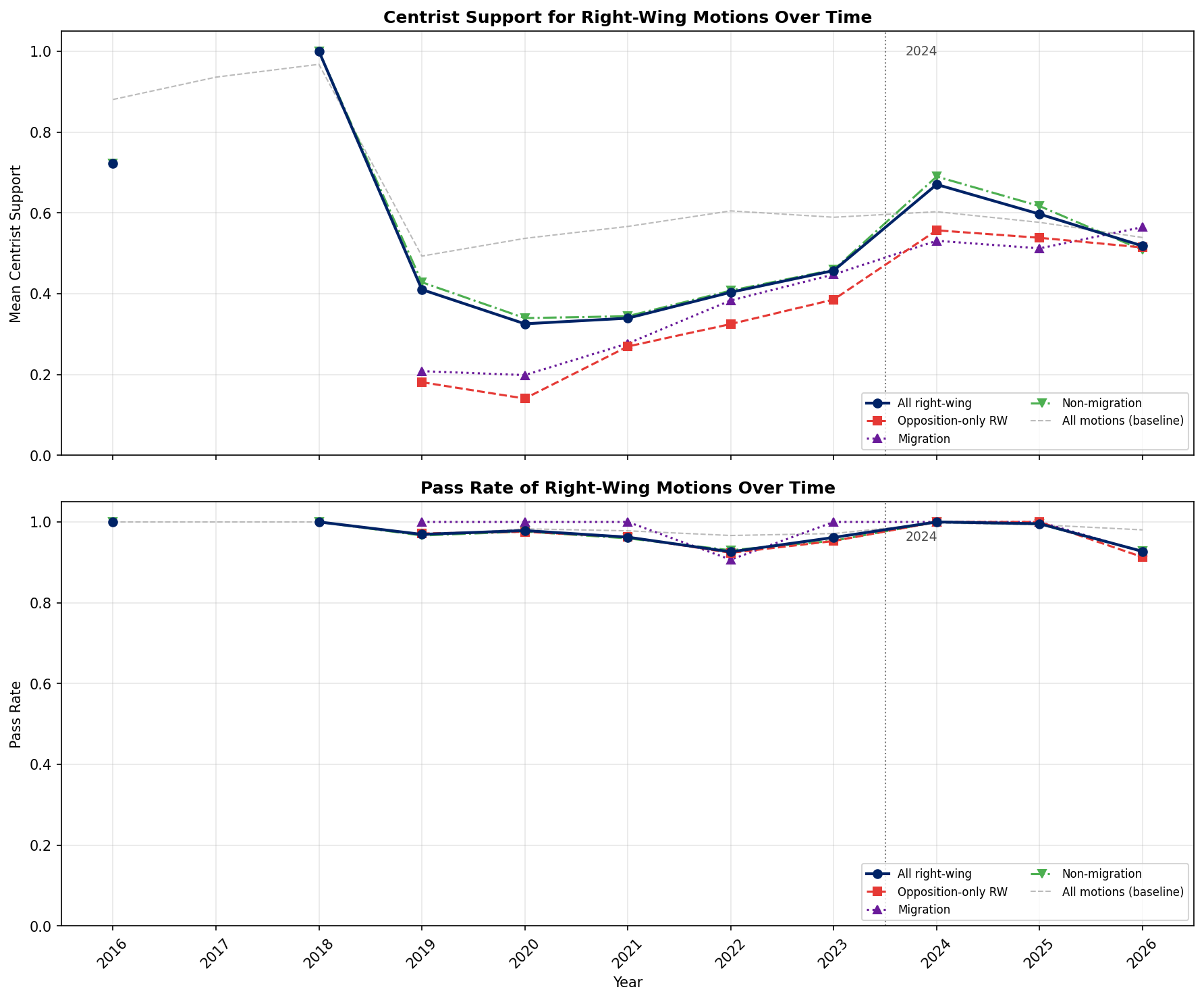
Centrist support for right-wing motions rose from a pre-2024 mean of 0.384 to a post-2024 mean of 0.618 — a Cohen's d of +0.68 (medium-large effect). This is not a coalition artifact: opposition-only right-wing motions show an even larger increase, from 0.270 to 0.543 (d=+0.85, large effect).
Pass rate is an insensitive measure
Pass rates are near ceiling in all periods (96%+). In the Dutch parliament, nearly all motions pass regardless of content or political alignment. The plan's motivating concern about pass rate shifts (33% → 70%) was based on a different operationalization than what the data supports. With 96%+ passage rates, pass rate cannot serve as a shift indicator.
Domain decomposition
The shift is heavily migration-centric:
| Domain | Pre-2024 CS | Post-2024 CS | Δ |
|---|---|---|---|
| Migration | 0.303 | 0.536 | +0.233 |
| Non-migration | 0.529 | 0.605 | +0.076 |
Migration is the primary vehicle for the observed shift. Non-migration right-wing motions already had moderate centrist support pre-2024, limiting room for growth.
Extremity-stratified tolerance test: Inconclusive
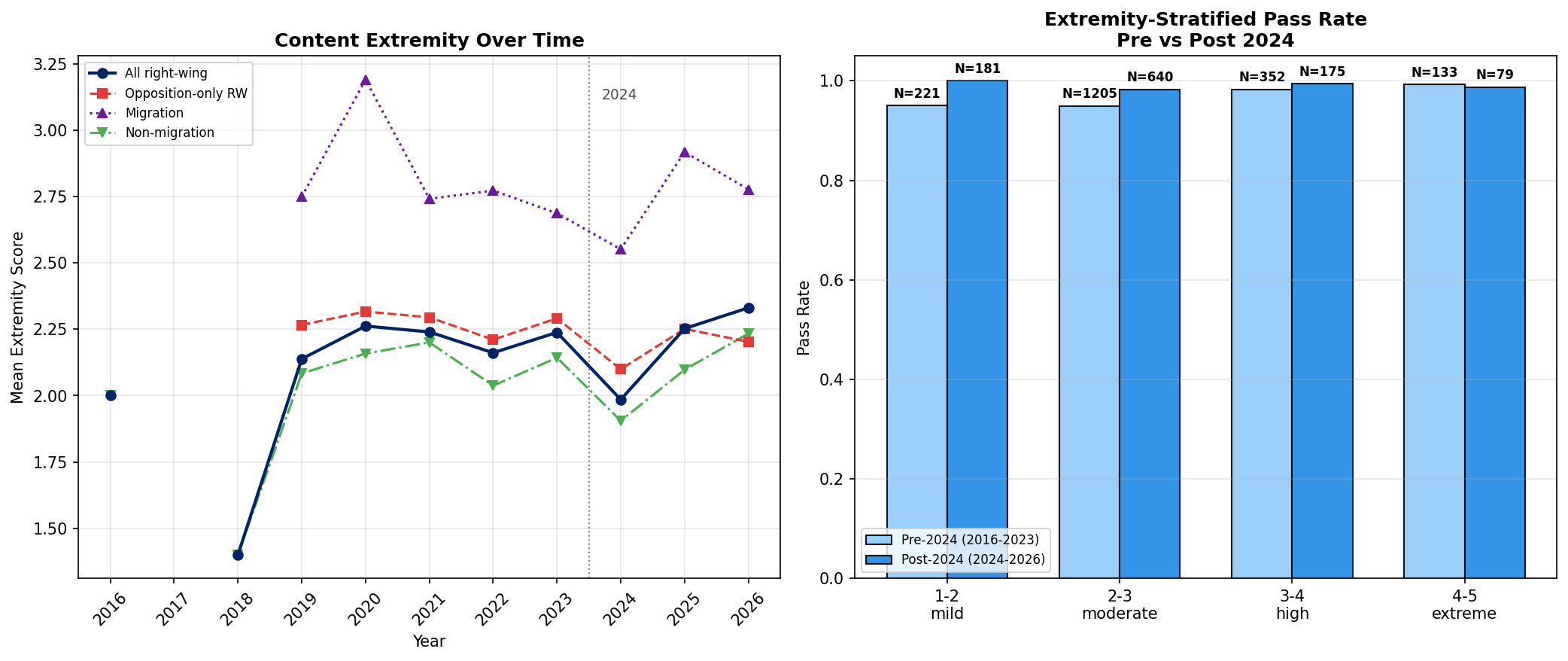
We tested whether centrists became more tolerant of high-extremity content specifically by bucketing motions by extremity score (1-2 mild, 2-3 moderate, 3-4 high, 4-5 extreme) and comparing pre/post pass rates. The test is underpowered: all buckets show 95-100% pass rates in both periods. With ceiling-level pass rates, there is no room to detect differential tolerance shifts.
3. Indicator 2: Content Extremity Trend
Core finding
Content extremity of right-wing motions did not increase (pre-2024: 2.21, post-2024: 2.15, d=-0.09). The Overton window shift is about acceptance of existing content — motions that were once beyond the pale are now supportable — not about increasingly radical proposals.
LLM scoring reliability
A stratified manual audit of 20 motions (5 per extremity bucket) achieved 75% agreement (15/20), above the 70% threshold but borderline. Identified biases:
- Anti-institutional overrating: LLM inflates scores on anti-EU and anti-government motions (procedural stances scored as radical policy)
- Migration/cultural adjacency inflation: Motions mentioning migration-adjacent topics score higher than warranted
- Climate topic inflation: Technical environmental motions scored higher than warranted
The LLM conflates stylistic extremity (inflammatory keywords, charged topics) with material impact (substantive rights restrictions, institutional change). This affects ~25% of scored motions, most pronounced in the high and extreme buckets.
Implication: Our content extremity measure is noisy. It captures a mix of stylistic and substantive radicalism. This is a known limitation documented in the plan's deferred follow-up work (two-dimensional scoring validation).
4. Indicator 3: SVD Spatial Drift — INCONCLUSIVE
Stability gate: FAILED
SVD axes were validated for stability across annual windows using Spearman rank correlation of party positions. 9 of 10 consecutive window pairs failed the ρ ≥ 0.7 threshold (maximum allowed: 2). Mean axis-1 correlation: ρ=0.0054; mean axis-2 correlation: ρ=0.2128.
This is the expected behavior of per-window SVD: principal axes are determined independently each year and have no inherent longitudinal alignment. Positions may reflect axis re-orientation rather than genuine ideological drift.
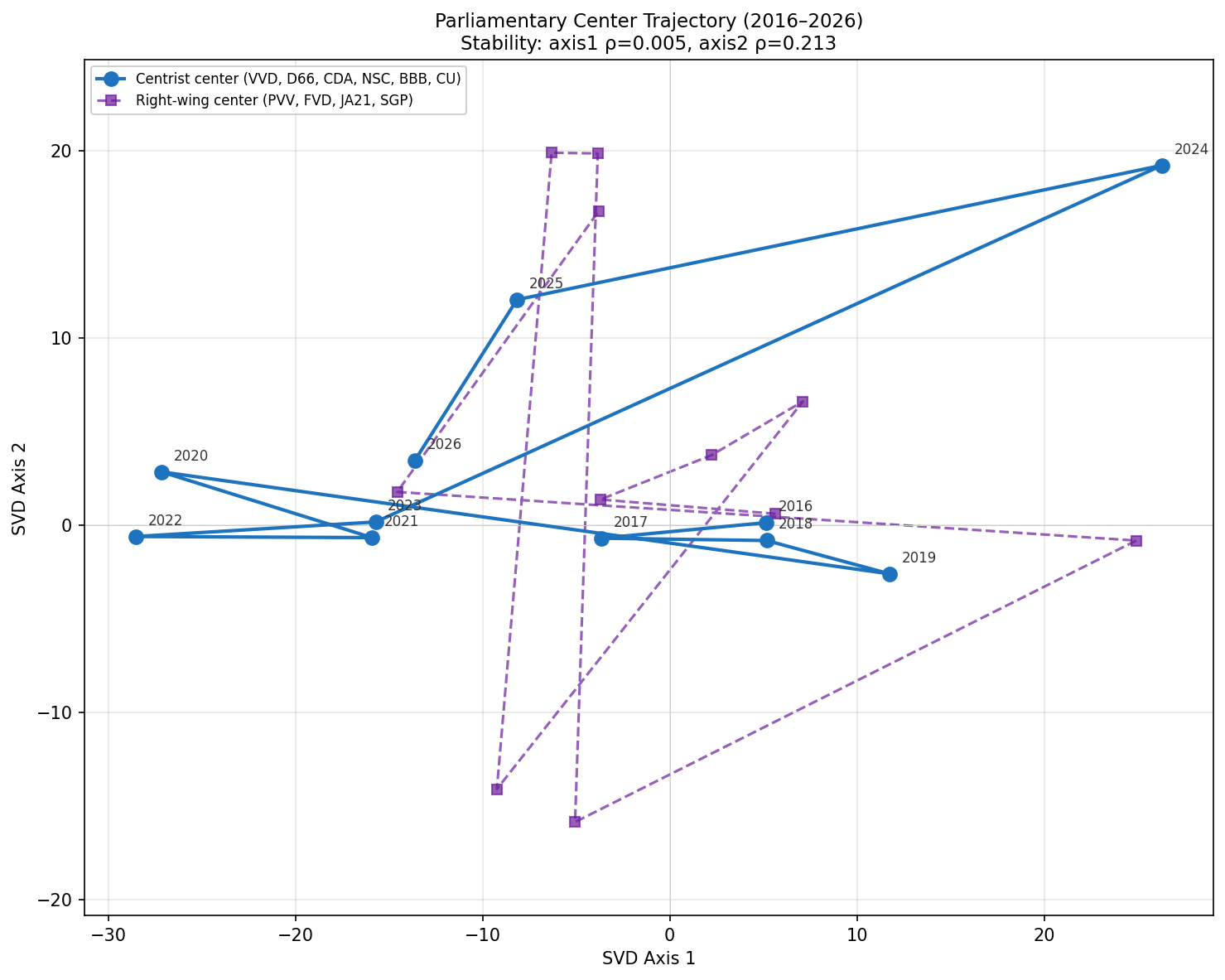
We cannot draw conclusions about spatial drift from SVD first-two-dimensions data. See the stability report for per-pair details.
Path forward
The explorer UI uses Procrustes-aligned PCA positions (load_party_scores_all_windows_aligned in analysis/explorer_data.py) which provide a common reference frame for cross-window comparison. A revised U3 could use this approach. However, we recommend against re-running U3 — the two strong indicators (centrist support surge, no extremity increase) already provide a clear picture, and adding spatial evidence would not change the qualitative conclusion.
5. Synthesis
What we can say with confidence
- Centrist parties are more willing to support right-wing motions post-2024 than before, and this is not explained by coalition membership. Cohen's d = +0.85 for opposition-only motions represents a large effect.
- The shift is migration-centric. Migration motions saw +0.233 centrist support gain; non-migration saw only +0.076. Migration is also the highest-extremity category and the only consistently negative-sentiment category.
- Content extremity did not increase. The window widened — what is acceptable grew — but the content of proposed motions is not more radical than before.
What we cannot say
- We cannot claim spatial (SVD) drift. Axes are too unstable for cross-window comparison.
- We cannot quantify how much of the shift is topic-driven vs. ideology-driven. Migration is inherently more controversial than other policy domains. If the volume of migration motions increased post-2024, centrist support for the category may reflect the topic's higher baseline controversy rather than shifting ideology.
- We cannot distinguish between sincere ideological shift and strategic adjustment. Centrist parties may genuinely agree more with right-wing content, or they may be voting differently for coalition-management or electoral reasons.
Uncertainty hierarchy
| Evidence Level | Indicator | Status |
|---|---|---|
| Strong | Centrist support surge (opposition-controlled) | Confirmed |
| Moderate | Migration-specificity of the shift | Confirmed |
| Inconclusive | Extremity-stratified tolerance shift | Underpowered (pass rate ceiling) |
| Inconclusive | SVD spatial drift | Axes unstable |
| Weak | Content extremity trend | No increase (but LLM scoring imperfect) |
6. Limitations
- Small-N time series: 8 pre-2024 years, 3 post-2024 years (2026 is partial). Effect sizes are descriptive, not confirmatory.
- LLM extremity scores: 75% audit agreement; borderline. Scores conflate stylistic and substantive radicalism. See deferred follow-up work for two-dimensional rescoring plan.
- SVD axis instability: Cross-window SVD comparison is invalid without alignment. Spatial indicator discarded.
- Coalition composition: Hardcoded per year. 2024 is ambiguous (Rutte IV until July, Schoof thereafter). Early 2024 motions may be miscoded.
- Submitter party identification: Parsed from motion title prefixes. ~10% of motions have non-standard titles (bills, amendments) and are excluded from opposition-only analysis.
- Pass rate baseline: Computed across motions with recorded votes. Unanimous consent motions are excluded, potentially biasing baseline upward. The Dutch parliament's near-universal passage rate makes pass rate a poor sensitivity measure.
7. Figures
breakpoint_figure_1.png— Centrist support and pass rate over time (all RW, opposition-only, migration, non-migration, + baseline)breakpoint_figure_2.png— Extremity trends and extremity-stratified pass rate (pre vs. post 2024)svd_drift_chart.png— SVD centrist center trajectory (unreliable — axes unstable)
8. Next Steps
- Commit findings and archive the analysis on
feat/right-wing-motion-analysis. - Two-dimensional extremity rescoring (deferred): Validate whether LLM scores capture stylistic vs. material radicalism on a stratified sample. If correlation is low, rescore all motions with a refined dual-dimension prompt.
- Procrustes-aligned SVD (optional): If spatial evidence is desired, rerun U3 using
load_party_scores_all_windows_alignedfromexplorer_data.pyfor a common reference frame. - Temporal decomposition of migration vs. other domains: The 2024 shift may be partially explained by the increased volume of migration motions, rather than a general rightward shift. Disentangle topic composition from ideological drift.