
11 KiB
Overton Window Breakpoint Analysis
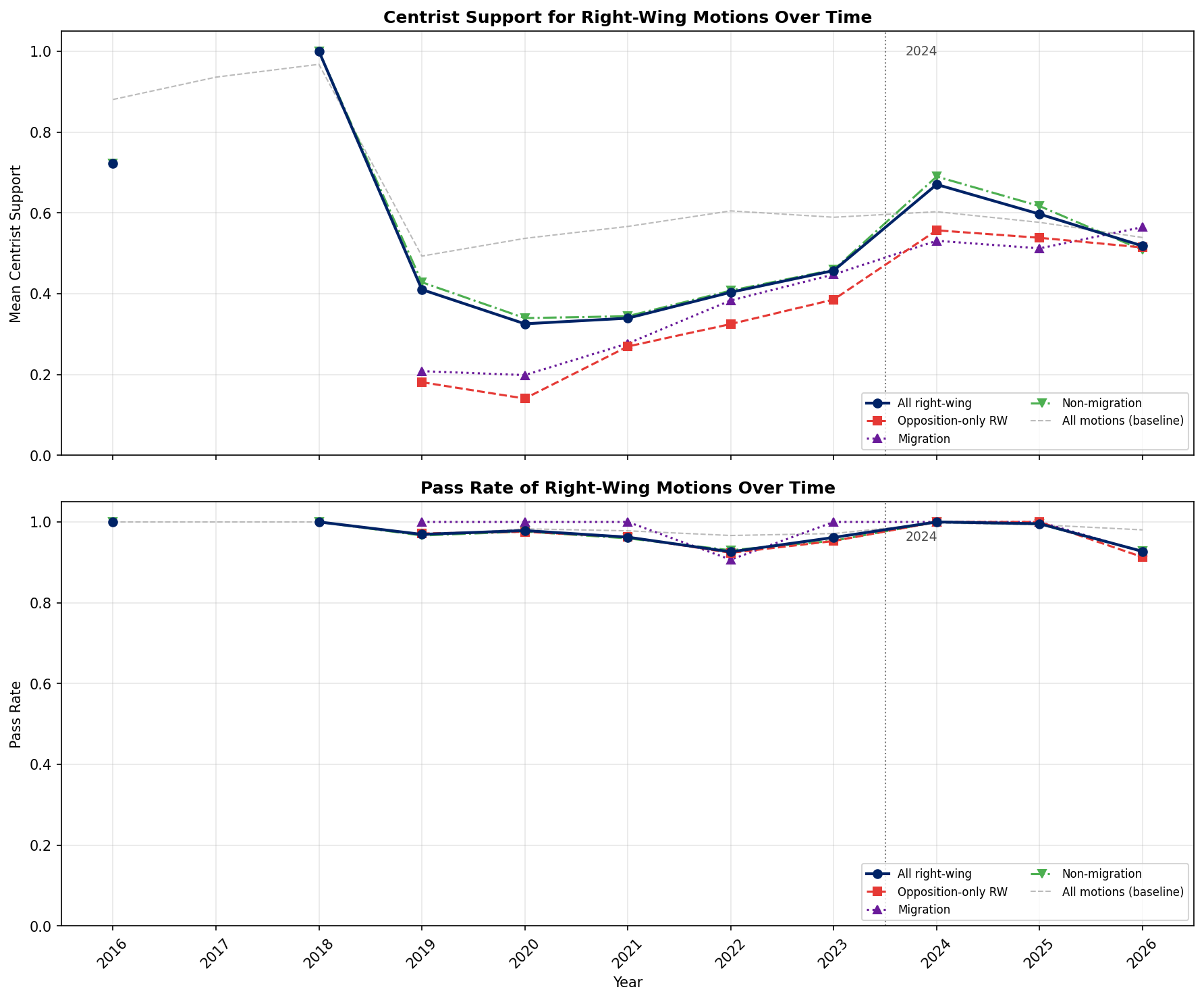
Goal: Quantify the 2024 structural break in centrist support, pass rates, and content extremity for right-wing motions in the Tweede Kamer.
Analysis period: 2016–2026 Right-wing parties: PVV, FVD, JA21, SGP Centrist parties: VVD, D66, CDA, NSC, BBB, CU Left parties: PvdA, GL, SP, PvdD, Volt, DENK, Bij1
1. Yearly Aggregate Metrics (All Right-Wing Motions)
| Year | N (RW) | Centrist Support | Pass Rate | Extremity | Right Support | Left Opp. |
|---|---|---|---|---|---|---|
| 2016 | 6 | 0.722 | 1.000 | 2.00 | 1.000 | 0.708 |
| 2017 | 0 | N/A | N/A | N/A | N/A | N/A |
| 2018 | 5 | 1.000 | 1.000 | 1.40 | 0.800 | 0.480 |
| 2019 | 195 | 0.410 | 0.969 | 2.14 | 0.838 | 0.746 |
| 2020 | 469 | 0.326 | 0.979 | 2.26 | 0.818 | 0.758 |
| 2021 | 425 | 0.339 | 0.962 | 2.24 | 0.903 | 0.788 |
| 2022 | 446 | 0.404 | 0.926 | 2.16 | 0.891 | 0.820 |
| 2023 | 365 | 0.457 | 0.962 | 2.24 | 0.900 | 0.821 |
| 2024 | 469 | 0.670 | 1.000 | 1.99 | 0.885 | 0.756 |
| 2025 | 455 | 0.597 | 0.996 | 2.25 | 0.895 | 0.799 |
| 2026 | 151 | 0.518 | 0.927 | 2.33 | 0.916 | 0.834 |
2. Pre/Post 2024 Comparison
Break year: 2024
All right-wing motions
| Metric | Pre-2024 Mean | Post-2024 Mean | Δ | Cohen's d |
|---|---|---|---|---|
| Centrist Support | 0.384 | 0.618 | +0.234 | +0.68 |
| Pass Rate | 0.959 | 0.988 | +0.029 | +0.18 |
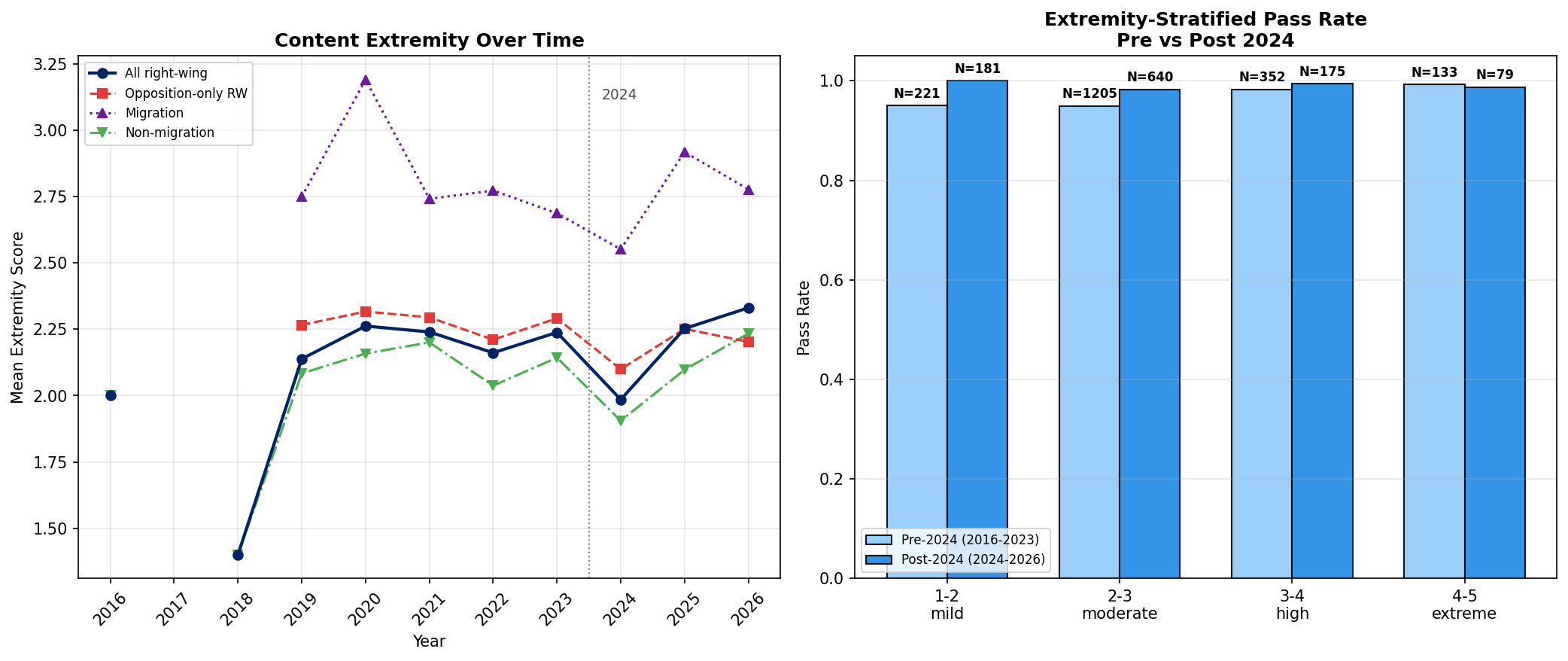
| Extremity | 2.21 | 2.15 | -0.07 | -0.09 |
Interpretation: Cohen's d values quantify effect sizes (|d| < 0.2 small, 0.5 medium, > 0.8 large). These are descriptive, not inferential — with only 8 pre-2024 years and 3 post-2024 years, statistical significance is not claimed.
Opposition-only right-wing motions
| Metric | Pre-2024 Mean | Post-2024 Mean | Δ | Cohen's d | N pre / N post |
|---|---|---|---|---|---|
| Centrist Support | 0.270 | 0.543 | +0.272 | +0.85 | 1295 / 405 |
| Pass Rate | 0.954 | 0.985 | +0.031 | +0.18 | 1295 / 405 |
| Extremity | 2.28 | 2.18 | -0.10 | -0.14 | 1295 / 405 |
Interpretation gate: If opposition metrics also rise post-2024, the shift is not purely coalition-driven. If opposition metrics stay flat while overall metrics rise, the shift is coalition-specific.
3. Coalition Composition
2016-2017: Rutte II (VVD/PvdA). 2018-2021: Rutte III (VVD/CDA/D66/CU). 2022-2023: Rutte IV (VVD/D66/CDA/CU). 2024-2026: Schoof (PVV/VVD/NSC/BBB). 2024 ambiguous: Schoof cabinet started July 2024; all 2024 motions are coded to the Schoof coalition. Coalition effect may be overestimated for early 2024.
Submitter party is parsed from motion title prefixes (e.g., "Motie van het lid Wilders over ..."). Only the lead submitter's party is considered. Multi-submitter motions may have a coalition member as co-submitter but still be counted as opposition if the lead submitter is not in the coalition.
4. Domain Decomposition
Migration = category asiel/vreemdelingen. Non-migration = all other categories.
| Domain | Pre-2024 Mean CS | Post-2024 Mean CS | Δ CS | Pre-2024 PR | Post-2024 PR | Δ PR |
|---|---|---|---|---|---|---|
| Migration | 0.303 | 0.536 | +0.233 | 0.981 | 0.975 | -0.006 |
| Non-migration | 0.529 | 0.605 | +0.076 | 0.969 | 0.974 | +0.005 |
5. Extremity-Stratified Pass Rate
| Bucket | Period | N | Pass Rate | Δ (post-pre) |
|---|---|---|---|---|
| 1-2 (mild) | Pre-2024 | 221 | 0.950 | |
| Post-2024 | 181 | 1.000 | +0.050 | |
| 2-3 (moderate) | Pre-2024 | 1205 | 0.949 | |
| Post-2024 | 640 | 0.983 | +0.033 | |
| 3-4 (high) | Pre-2024 | 352 | 0.983 | |
| Post-2024 | 175 | 0.994 | +0.011 | |
| 4-5 (extreme) | Pre-2024 | 133 | 0.992 | |
| Post-2024 | 79 | 0.987 | -0.005 |
Key test: If high-extremity motions (3–5) went from low pass rate to high pass rate while mild motions stayed flat, centrists are more tolerant of extreme content — direct Overton shift evidence. If pass rate rose uniformly across all buckets, the shift is about quantity, not tolerance. If only the 1–2 bucket rose, right-wing parties filed milder motions post-2024 and the 'shift' is illusory.
6. Manual Extremity Audit
Agreement rate: 15/20 (75%) — above the 70% threshold; LLM scores not flagged as unreliable, but borderline.
Identified systematic biases:
- Anti-institutional overrating: LLM inflates scores on anti-EU, anti-government motions (e.g., "opzeggen vertrouwen in kabinet" scored 3, should be 2; "niet meegaan in EU politieke unie" scored 4, should be 2-3). Procedural or stance-taking motions scored as radical policy.
- Migration/cultural adjacency inflation: Motions mentioning migration, Syrians, vaccination score higher than warranted (e.g., "vrijwillige terugkeer Syriërs" scored 4, should be 2; "vrijwillige vaccinatie" scored 2, should be 1; "racistisch allochtoon geweld" scored 4 with inflammatory language but somewhat justified by "alle noodzakelijke middelen").
- Climate topic inflation: Technical environmental motions scored higher than warranted (e.g., "emissiegegevens beter afbakenen" scored 3, should be 2).
Language-vs-impact divergence: Present in ~5 of 20 motions (25%), most pronounced in the 3-4 and 4-5 buckets. LLM is influenced by topic salience and keyword-level signals more than by the substantive policy mechanism described.
| # | Year | Category | LLM Score | Bucket | Agreed? | Driver | Notes |
|---|---|---|---|---|---|---|---|
| 1 | 2024 | economie/belasting | 1 | 1-2 (mild) | Y | Policy | EU directive implementation; routine |
| 2 | 2020 | economie/belasting | 1 | 1-2 (mild) | Y | Policy | Symbolic support for KLM; mild |
| 3 | 2019 | veiligheid/justitie | 1 | 1-2 (mild) | Y | Policy | Budget procedural; trivial |
| 4 | 2025 | economie/belasting | 1 | 1-2 (mild) | Y | Policy | Tax bracket indexing; routine |
| 5 | 2022 | sociaal/jeugd | 1 | 1-2 (mild) | Y | Policy | One-time parent benefit; limited scope |
| 6 | 2021 | corona/pandemie | 2 | 2-3 (moderate) | Y | Policy | Sport venue regulation; moderate |
| 7 | 2021 | zorg/gezondheid | 2 | 2-3 (moderate) | N (→1) | Language | Voluntary vaccination for at-risk; COVID rhetoric inflates |
| 8 | 2020 | economie/belasting | 2 | 2-3 (moderate) | Y | Policy | Government influence on port; moderate |
| 9 | 2025 | veiligheid/justitie | 2 | 2-3 (moderate) | Y | Both | Police oath reform; symbolic + mild policy |
| 10 | 2020 | economie/belasting | 2 | 2-3 (moderate) | Y | Policy | Corporate tax carryback; narrow fiscal |
| 11 | 2020 | veiligheid/justitie | 3 | 3-4 (high) | N (→2) | Language | Motion of no-confidence is parliamentary procedure, not radical policy |
| 12 | 2025 | klimaat/milieu | 3 | 3-4 (high) | N (→2) | Policy | Emission data scoping; narrow technical fix, inflated by climate topic |
| 13 | 2019 | asiel/vreemdelingen | 3 | 3-4 (high) | Y | Policy | Withdraw from UN Refugee Pact; substantive |
| 14 | 2019 | landbouw/stikstof | 3 | 3-4 (high) | Y | Policy | Substantially relax nitrogen rules; high environmental impact |
| 15 | 2020 | klimaat/milieu | 3 | 3-4 (high) | Y | Both | Wolf culling permits; inflammatory topic but permit-framework |
| 16 | 2020 | veiligheid/justitie | 4 | 4-5 (extreme) | Y | Both | "Street terrorists" + denaturalization; both inflammatory and materially extreme |
| 17 | 2021 | defensie/buitenland | 4 | 4-5 (extreme) | N (→2-3) | Language | Standard Eurosceptic position; "niet meegaan in verdere integratie" is moderate |
| 18 | 2023 | asiel/vreemdelingen | 4 | 4-5 (extreme) | Y | Policy | Asylum stop; radical policy against international obligations |
| 19 | 2025 | asiel/vreemdelingen | 4 | 4-5 (extreme) | N (→2) | Language | Voluntary return of Syrians is moderate policy; migration topic inflates |
| 20 | 2019 | sociaal/jeugd | 4 | 4-5 (extreme) | Y | Both | "All necessary means against racist immigrant violence"; inflammatory + broad powers |
7. Limitations
- Small-N time series: 8 pre-2024 years and at most 3 post-2024 years (2026 is partial). Effect sizes are descriptive, not confirmatory.
- LLM extremity scores: Content-based, not independently validated beyond the manual audit above. See §6 for agreement rate and noted biases.
- Coalition composition: Hardcoded per year. 2024 is ambiguous (Rutte IV until July, Schoof thereafter). Early 2024 motions may be miscoded as Schoof-era.
- Submitter party identification: Parsed from motion title prefixes (e.g., 'Motie van het lid X'). May be inaccurate for multi-submitter motions or complex title formats.
- Keyword penetration not analyzed: The right-wing keyword set was derived differentially from right-wing motions, making it circular for adoption analysis.
- Pass rate baseline: Computed across all motions with voting data. Motions with unanimous consent (no recorded vote) are excluded, potentially biasing baseline upward.
8. Figures
9. Conclusion
Core finding: Centrist support for right-wing motions surged post-2024 (d=+0.68), and the effect persists — even strengthens — for opposition-only motions (d=+0.85). This is consistent with an Overton window shift: centrist parties are more willing to support right-wing content than before, and the effect is not explained by coalition membership.
However, three important qualifications temper a strong Overton-shift interpretation:
-
Content extremity did not increase (d=-0.09). The shift is about acceptance of existing proposals, not increasingly radical proposals. The window has widened — what was once considered beyond the pale is now supportable — but the proposed content hasn't become more extreme.
-
Pass rate is near ceiling (96%+ in all periods). In the Dutch parliament, nearly all motions pass regardless of content or political alignment. Pass rate is insensitive as a shift indicator. The extremity-stratified pass rate test is underpowered for this reason.
-
LLM extremity scores are imperfect (75% audit agreement; borderline). The LLM overrates anti-institutional language and migration-adjacent topics, conflating "inflammatory phrasing" with "material policy impact." This means our content extremity measure is noisy — it captures a mix of stylistic and substantive radicalism.
The migration-centric pattern
The shift is concentrated in migration (centrist support Δ=+0.233) with non-migration showing a much smaller effect (Δ=+0.076). Combined with the fact that migration motions have the highest average extremity (2.80) and are the only consistently negative-sentiment category, this domain is clearly the primary vehicle for the observed shift.