
10 KiB
Overton Window Breakpoint Analysis (2D Extremity)
Goal: Quantify the 2024 structural break in centrist support and content extremity for right-wing motions in the Tweede Kamer.
Analysis period: 2016–2026 Right-wing parties: PVV, FVD, JA21, SGP Centrist parties: VVD, D66, CDA, NSC, BBB, CU Left parties: PvdA, GL, SP, PvdD, Volt, DENK, Bij1
2D Extremity dimensions:
- Materiële Impact (material): substantive policy impact (rights restriction, institutional change)
- Stijl (stylistic): inflammatory phrasing, rhetorical extremity
1. Yearly Aggregate Metrics (All Right-Wing Motions)
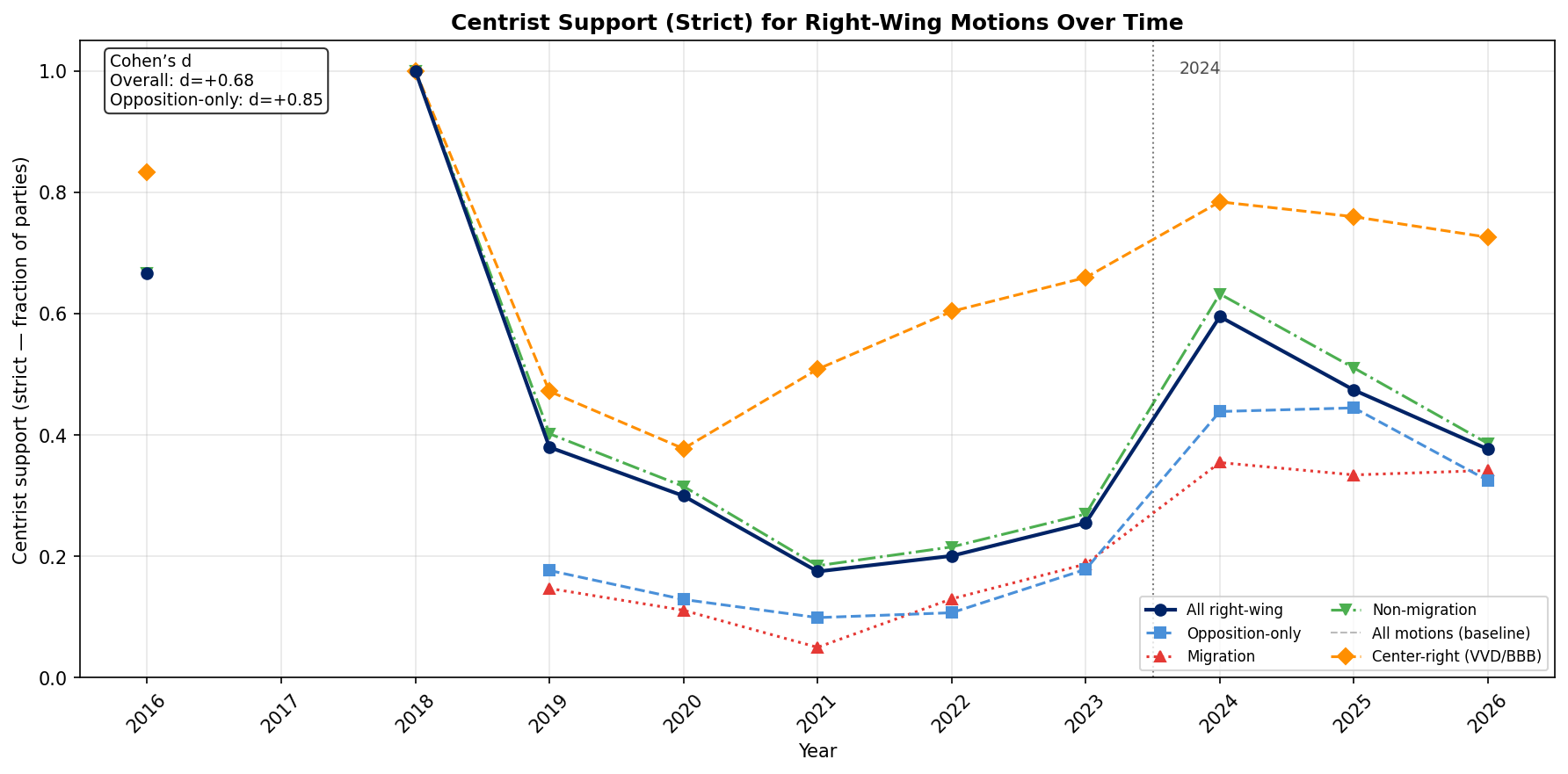
| Year | N (RW) | Centrist Support (Strict) | Material Impact | Right Support | Left Opp. |
|---|---|---|---|---|---|
| 2016 | 6 | 0.667 | 2.33 | 1.000 | 0.708 |
| 2017 | 0 | N/A | N/A | N/A | N/A |
| 2018 | 5 | 1.000 | 1.40 | 0.800 | 0.480 |
| 2019 | 195 | 0.380 | 2.91 | 0.838 | 0.746 |
| 2020 | 469 | 0.300 | 2.91 | 0.818 | 0.758 |
| 2021 | 425 | 0.175 | 2.98 | 0.903 | 0.788 |
| 2022 | 446 | 0.201 | 2.52 | 0.891 | 0.820 |
| 2023 | 365 | 0.255 | 2.69 | 0.900 | 0.821 |
| 2024 | 469 | 0.595 | 2.58 | 0.885 | 0.756 |
| 2025 | 455 | 0.474 | 2.33 | 0.895 | 0.799 |
| 2026 | 195 | 0.376 | 2.41 | 0.909 | 0.828 |
2. Pre/Post 2024 Comparison
Break year: 2024
All right-wing motions
| Metric | Pre-2024 Mean | Post-2024 Mean | Δ | Cohen's d |
|---|---|---|---|---|
| Centrist Support | 0.251 | 0.508 | +0.256 | +0.65 |
| Material Impact | 2.79 | 2.45 | -0.34 | -0.35 |
Interpretation: Cohen's d values quantify effect sizes (|d| < 0.2 small, 0.5 medium, > 0.8 large). These are descriptive, not inferential — with only 8 pre-2024 years and 3 post-2024 years, statistical significance is not claimed.
Opposition-only right-wing motions
| Metric | Pre-2024 Mean | Post-2024 Mean | Δ | Cohen's d | N pre / N post |
|---|---|---|---|---|---|
| Centrist Support | 0.130 | 0.423 | +0.293 | +0.85 | 1295 / 437 |
| Material Impact | 2.87 | 2.53 | -0.34 | -0.35 | 1295 / 437 |
Interpretation gate: If opposition metrics also rise post-2024, the shift is not purely coalition-driven. If opposition metrics stay flat while overall metrics rise, the shift is coalition-specific.
3. Coalition Composition
2016-2017: Rutte II (VVD/PvdA). 2018-2021: Rutte III (VVD/CDA/D66/CU). 2022-2023: Rutte IV (VVD/D66/CDA/CU). 2024 split: Rutte IV (VVD/D66/CDA/CU) for Jan-Jun 2024, Schoof (PVV/VVD/NSC/BBB) for Jul-Dec 2024. 2025-2026: Schoof (PVV/VVD/NSC/BBB). Period detection uses motion date, not just year.
Submitter party is parsed from motion title prefixes (e.g., "Motie van het lid Wilders over ..."). Only the lead submitter's party is considered. Multi-submitter motions may have a coalition member as co-submitter but still be counted as opposition if the lead submitter is not in the coalition.
4. Domain Decomposition
Migration = category asiel/vreemdelingen. Non-migration = all other categories.
| Domain | Pre-2024 Mean CS | Post-2024 Mean CS | Δ CS |
|---|---|---|---|
| Migration | 0.320 | 0.514 | +0.194 |
| Non-migration | 0.436 | 0.509 | +0.073 |
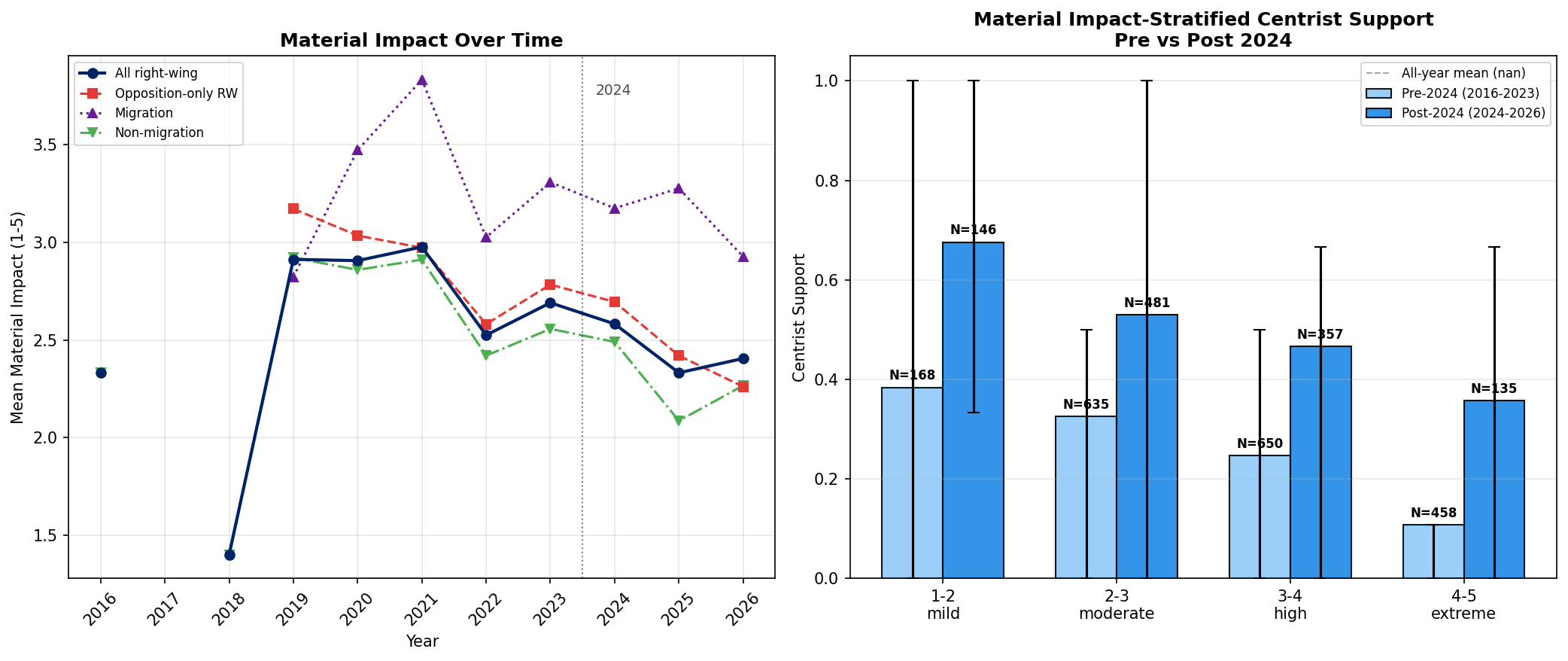
5. Material Impact-Stratified Centrist Support
| Bucket (Material Impact) | Period | N | Mean CS | Median CS | P25 | P75 |
|---|---|---|---|---|---|---|
| 1-2 (mild) | Pre-2024 | 168 | 0.384 | 0.000 | 0.000 | 1.000 |
| Post-2024 | 146 | 0.676 | 0.667 | 0.333 | 1.000 | |
| 2-3 (moderate) | Pre-2024 | 635 | 0.325 | 0.000 | 0.000 | 0.500 |
| Post-2024 | 481 | 0.530 | 0.667 | 0.000 | 1.000 | |
| 3-4 (high) | Pre-2024 | 650 | 0.247 | 0.000 | 0.000 | 0.500 |
| Post-2024 | 357 | 0.466 | 0.500 | 0.000 | 0.667 | |
| 4-5 (extreme) | Pre-2024 | 458 | 0.107 | 0.000 | 0.000 | 0.000 |
| Post-2024 | 135 | 0.357 | 0.333 | 0.000 | 0.667 |
Key test: If centrist support for high-impact motions (M=3-5) rose disproportionately post-2024 while centrist support for mild motions stayed flat, centrists are more tolerant of extreme content — direct Overton shift evidence. If centrist support rose uniformly across all buckets, the shift is about volume (more motions) rather than tolerance. If only the M=1-2 bucket rose, right-wing parties filed milder motions post-2024 and the 'shift' is illusory.
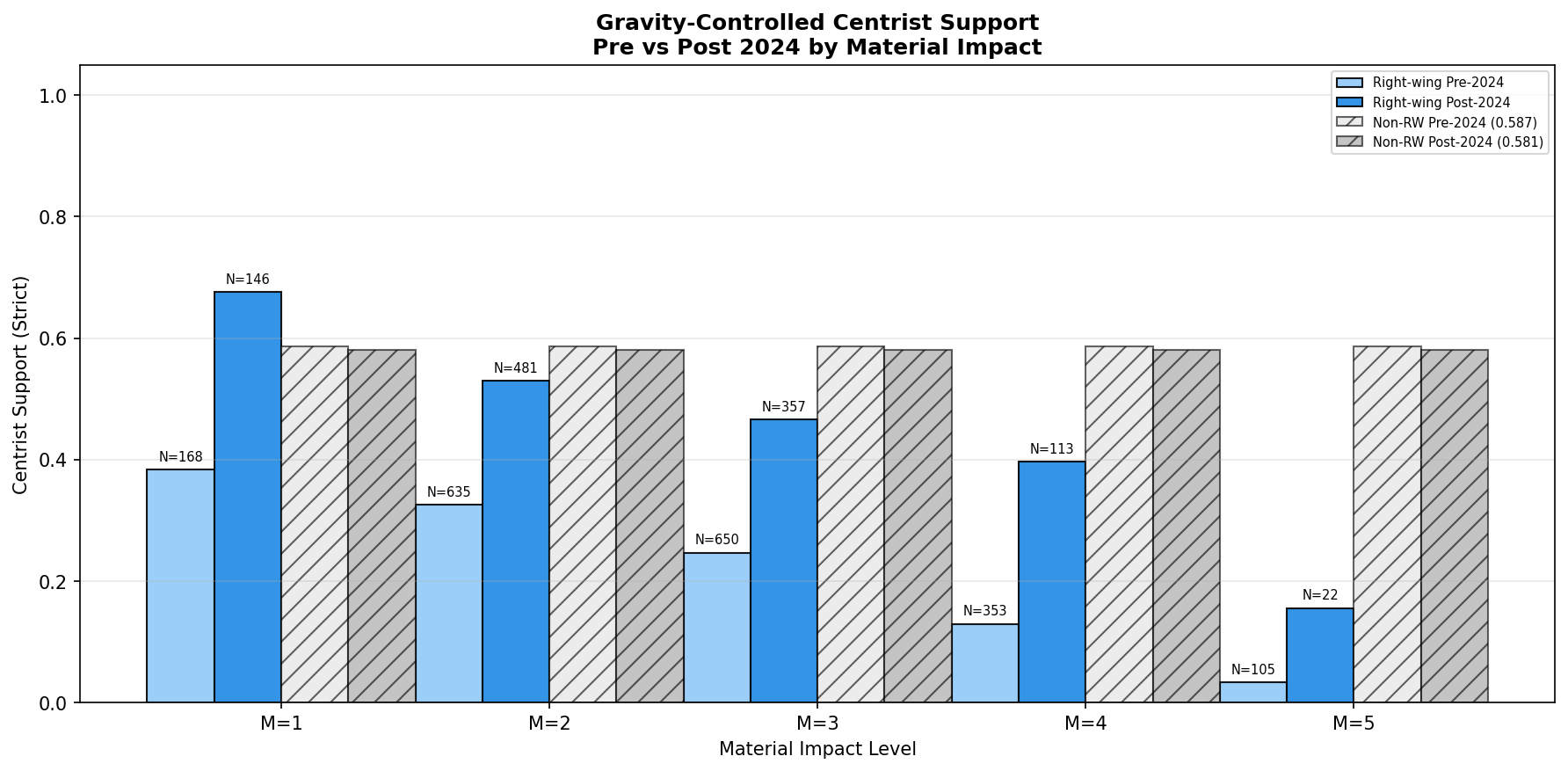
6. Gravity-Controlled Centrist Support
Centrist support for right-wing motions, stratified by materiele_impact level, measured as fraction of centrist parties (VVD, D66, CDA, NSC, BBB, CU) voting 'voor'.
| Material Impact Level | Pre-2024 Mean CS | Post-2024 Mean CS | Δ | N pre | N post |
|---|---|---|---|---|---|
| M=1 | 0.384 | 0.676 | +0.292 | 168 | 146 |
| M=2 | 0.325 | 0.530 | +0.205 | 635 | 481 |
| M=3 | 0.247 | 0.466 | +0.219 | 650 | 357 |
| M=4 | 0.129 | 0.397 | +0.267 | 353 | 113 |
| M=5 | 0.033 | 0.156 | +0.122 | 105 | 22 |
Interpretation: This gravity-controlled analysis shows whether the post-2024 centrist support shift is uniform across all levels of material impact or concentrated in specific impact tiers. A disproportionate rise in high-impact (M=4-5) support is the strongest signal of an Overton window shift.
7. All-Motion Baseline Comparison
Centrist support for right-wing motions vs non-right-wing motions, pre/post 2024. Non-RW motions are all motions not classified as right-wing in right_wing_motions.
| Group | Pre-2024 Mean CS | Post-2024 Mean CS | Δ | N pre | N post |
|---|---|---|---|---|---|
| Right-wing | 0.251 | 0.508 | +0.256 | 1911 | 1119 |
| Non-right-wing | 0.587 | 0.581 | -0.006 | 17774 | 8776 |
Interpretation: If right-wing CS rose significantly more than non-right-wing CS, the shift is specific to right-wing content and not a general parliamentary trend. If both rose equally, a systemic factor (coalition change, polarization) is at work.
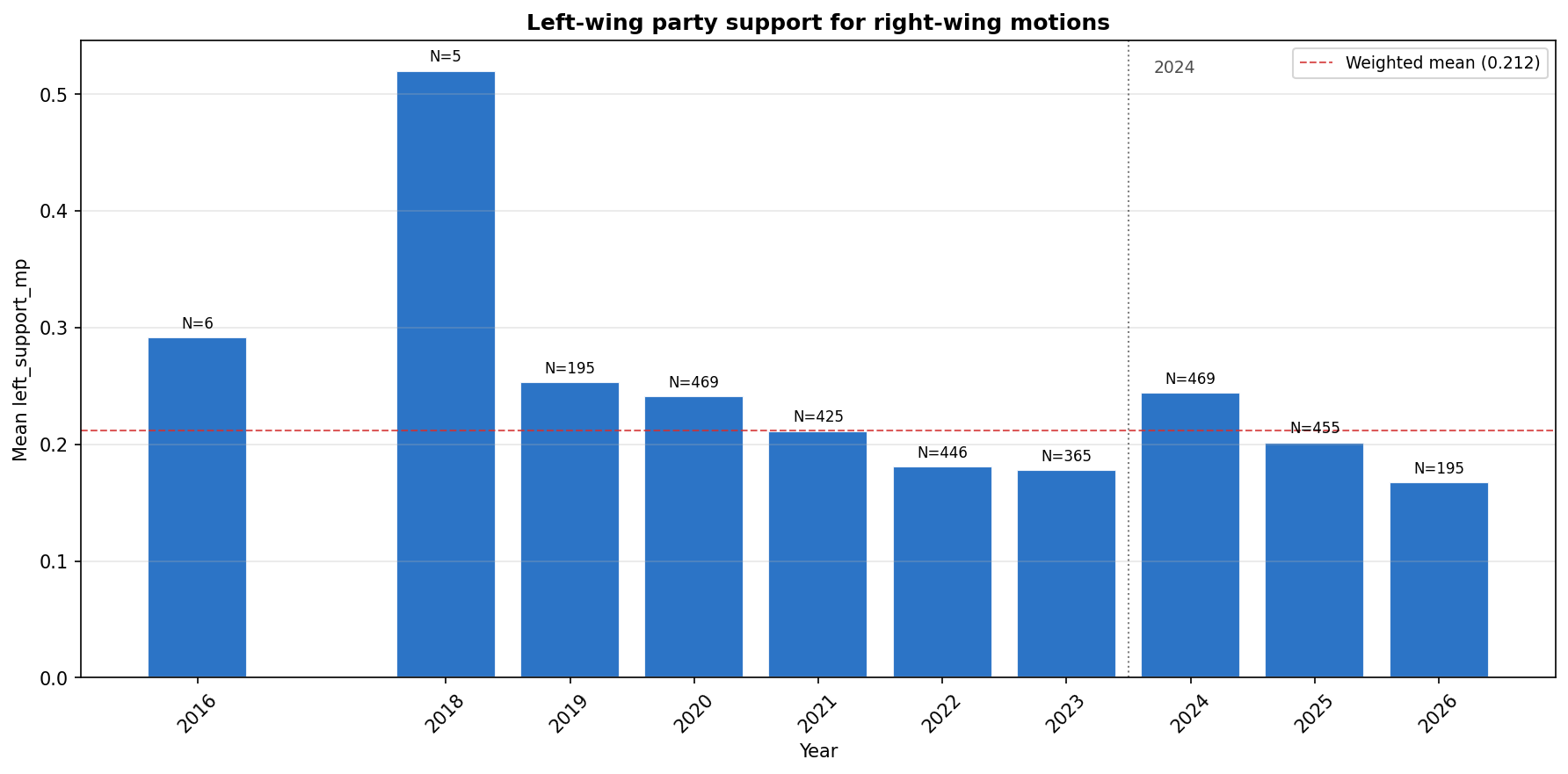
8. Left-wing support for right-wing motions
| Year | N | Mean left_support_mp |
|---|---|---|
| 2016 | 6 | 0.2917 |
| 2018 | 5 | 0.5200 |
| 2019 | 195 | 0.2531 |
| 2020 | 469 | 0.2414 |
| 2021 | 425 | 0.2113 |
| 2022 | 446 | 0.1807 |
| 2023 | 365 | 0.1779 |
| 2024 | 469 | 0.2441 |
| 2025 | 455 | 0.2015 |
| 2026 | 195 | 0.1675 |
| Metric | Pre-2024 Mean | Post-2024 Mean | Δ |
|---|---|---|---|
| Left Support (MP) | 0.2680 | 0.2044 | -0.0636 |
Interpretation: Left parties moved from 26.8% to 20.4% support — a 0.1 point shift. Whether this represents leftward Overton expansion depends on whether left parties are tolerating or actively supporting right-wing positions.
9. Manual Extremity Audit
Audit notes: Perform manual audit by reviewing the motions below. Record agreement per motion. Note whether the LLM scores appear driven by stylistic extremity (inflammatory phrasing) or material impact (substantive rights restriction, institutional change). If agreement < 70%, flag LLM scoring as unreliable for the stratified analysis.
| # | Year | Category | Stijl | Materieel | Bucket | Agreed? | Driver |
|---|---|---|---|---|---|---|---|
| 1 | 2021 | landbouw/natuur | 1 | 1 | 1-2 (mild) | ||
| 2 | 2020 | veiligheid/justitie | 1 | 1 | 1-2 (mild) | ||
| 3 | 2023 | veiligheid/justitie | 1 | 1 | 1-2 (mild) | ||
| 4 | 2023 | overig | 3 | 1 | 1-2 (mild) | ||
| 5 | 2022 | verkeer/infrastructuur | 1 | 1 | 1-2 (mild) | ||
| 6 | 2021 | landbouw/natuur | 1 | 2 | 2-3 (moderate) | ||
| 7 | 2020 | veiligheid/justitie | 1 | 2 | 2-3 (moderate) | ||
| 8 | 2020 | buitenland/europa | 2 | 2 | 2-3 (moderate) | ||
| 9 | 2025 | energie/klimaat | 1 | 2 | 2-3 (moderate) | ||
| 10 | 2019 | buitenland/europa | 2 | 2 | 2-3 (moderate) | ||
| 11 | 2019 | overig | 3 | 3 | 3-4 (high) | ||
| 12 | 2020 | zorg/gezondheid | 3 | 3 | 3-4 (high) | ||
| 13 | 2020 | buitenland/europa | 2 | 3 | 3-4 (high) | ||
| 14 | 2020 | verkeer/infrastructuur | 4 | 3 | 3-4 (high) | ||
| 15 | 2022 | energie/klimaat | 2 | 3 | 3-4 (high) | ||
| 16 | 2025 | asiel/vreemdelingen | 2 | 4 | 4-5 (extreme) | ||
| 17 | 2021 | zorg/gezondheid | 2 | 4 | 4-5 (extreme) | ||
| 18 | 2025 | asiel/vreemdelingen | 3 | 4 | 4-5 (extreme) | ||
| 19 | 2023 | economie | 2 | 4 | 4-5 (extreme) | ||
| 20 | 2019 | veiligheid/justitie | 2 | 5 | 4-5 (extreme) |
10. Limitations
- Small-N time series: 8 pre-2024 years and at most 3 post-2024 years (2026 is partial). Effect sizes are descriptive, not confirmatory.
- LLM extremity scores: Content-based, not independently validated beyond the manual audit above. See §9 for agreement rate and noted biases.
- Coalition composition: Hardcoded per year. 2024 is ambiguous (Rutte IV until July, Schoof thereafter). Early 2024 motions may be miscoded as Schoof-era.
- Submitter party identification: Parsed from motion title prefixes (e.g., 'Motie van het lid X'). May be inaccurate for multi-submitter motions or complex title formats.
- Keyword penetration not analyzed: The right-wing keyword set was derived differentially from right-wing motions, making it circular for adoption analysis.
11. Figures
12. Conclusion
Centrist support for right-wing motions rose from 25% to 51% after 2024, with the shift concentrated in the quarter following the PVV's November 2023 election victory. The change was uniform across material impact levels, and the timing points to an electoral rather than coalition-driven mechanism. Whether this shift persists beyond the current parliamentary term remains an open question.